


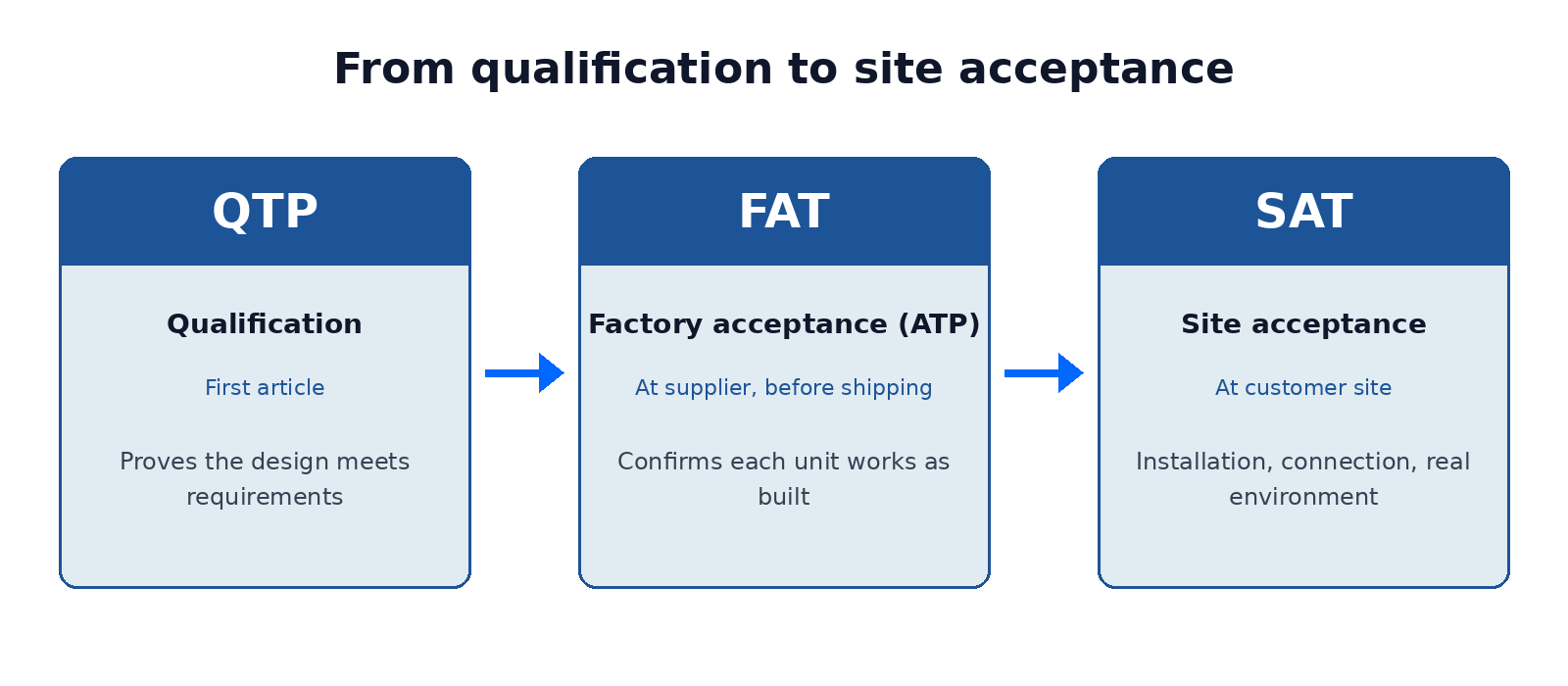
A QTP (Qualification Test Procedure) proves that a design meets its requirements. It usually runs once, on a representative unit (often the first article built to the final design), often with margins beyond normal use. An ATP (Acceptance Test Procedure) checks that each delivered unit works as specified before the customer accepts it. Qualification validates the design. Acceptance validates every unit built from it, once the design is qualified.
The two terms often appear together in specifications and purchase orders. They are easy to mix up. This article explains the difference and how each applies to a test bench or validation system.
What a QTP and an ATP each prove
QTP. A qualification test procedure describes the tests that show a design is fit for its specification. Space standards state it clearly. ECSS-E-ST-10-03C Testing (clause 4.5.2a) requires qualification testing “to provide evidence that the space segment element or equipment performs in accordance with its specifications in the intended environments with the specified qualification margins.” Qualification normally runs on a dedicated qualification unit, not on every production unit (clause 4.5.2b). It is repeated when the design, a critical component, the manufacturing process or the operating environment changes significantly. A QTP usually covers functional, performance, environmental and endurance tests. Test levels are often set above expected service conditions. MIL-HDBK-340A (3.5.6) calls this a qualification margin.
MIL-HDBK-340A (section 6.1) adds a point that matters to anyone buying test equipment. Qualification tests also “validate the planned acceptance program including test techniques, procedures, equipment, instrumentation, and software.” In other words, qualification is where the acceptance tests themselves are proven.
ATP. An acceptance test procedure checks that a specific manufactured unit conforms to its specification. It also checks that the unit is free from workmanship or material defects. ECSS-E-ST-10-03C (clause 4.5.3b) requires acceptance testing “to assure freedom from workmanship defects and flawed materials.” MIL-HDBK-340A (section 7.1) describes acceptance tests as demonstrating “the acceptability of each deliverable item.”
The ATP runs on every delivered unit. It is often executed first at the supplier’s facility, before shipment, as a Factory Acceptance Test (FAT). It is then repeated, fully or partly, at the customer’s site after installation, as a Site Acceptance Test (SAT). The SAT adds what the factory cannot show: correct installation, connection to the customer’s utilities and systems, and operation in the real environment. ECSS-E-ST-10-03C (clause 4.5.3c) specifies that acceptance comes after qualification is complete. Each test case needs an objective pass/fail criterion, agreed before execution. The ATP ends with a signed record: the customer accepts the unit, or lists the non-conformities to resolve first.
ATP vs QTP side by side
| QTP (qualification) | ATP (acceptance) | |
|---|---|---|
| Objective | Prove the design meets requirements | Prove each unit conforms and is free of defects |
| Unit tested | Representative / qualification unit | Every delivered unit |
| Frequency | Once per design, or after a significant change | Every unit, every delivery |
| Stress levels | Often beyond expected service conditions (qualification margins) | Up to expected service conditions, below qualification levels (acceptance levels) |
| Who signs | Design authority and customer | Customer (and supplier quality) |
| Deliverable | Qualification test report | ATP report / acceptance certificate per unit |
Generic summary based on ECSS-E-ST-10-03C and MIL-HDBK-340A. Exact roles and levels are set by each contract.
How ATP and QTP apply to a test bench
A test bench has two roles. It is a product that must itself be accepted. It is also often the tool that runs the customer’s own qualification and acceptance tests.
HIL benches. For a Hardware-in-the-Loop (HIL) bench, the ATP typically verifies I/O channels, signal conditioning, communication buses and real-time model execution. It also checks the automated test sequences delivered with the bench. Fault injection is covered too: short to ground or supply, open circuit. So are a calibration check of the measurement channels and the repeatability of test sequences. Once accepted, the bench is used to qualify and accept ECUs.
Battery and BMS validation systems. Acceptance covers cell and pack emulation and measurement accuracy against the specification. It includes the accuracy of emulated cell voltages and the current capability. It checks safety functions: emergency stop, interlocks and insulation monitoring. It also covers fault injection (overvoltage, undervoltage, temperature) and communication with the Battery Management System (BMS) under test.
End-of-Line and wiring-harness testers. End-of-Line (EOL) and harness testers are themselves acceptance tools. They run an ATP-like check on every production unit. Their own acceptance verifies continuity and insulation measurements, fixtures, cycle time and traceability of results. It should prove detection of a known defective part, with known-good and known-bad reference samples. The goal is no false pass and no false reject. It should also show measurement repeatability through a gauge R&R (repeatability and reproducibility) study. Connector keying and locking checks are part of it as well.
RAYNOV applies a structured acceptance procedure to the systems it delivers. Tests are based on requirements and traced from requirements to test cases, results, issues and final validation reports. The cycle runs from requirements and test planning to test development, execution, issue resolution and final acceptance. See our ATP methodology.
Common mistakes to avoid
- Acceptance criteria not quantified. “Works correctly” cannot be signed off. Each criterion needs a value, a tolerance or an observable result.
- Tests not traced to requirements. Without a traceability matrix, gaps appear only at the end, when they cost the most to fix.
- Skipping requalification after a design change. A new component or firmware can invalidate earlier qualification results.
- Using the ATP instead of qualification. Passing acceptance on one unit does not prove the design has margin.
FAQ
Is ATP the same as FAT? Not exactly. The ATP is the procedure document. A FAT (Factory Acceptance Test) is the acceptance campaign run with that procedure at the supplier’s facility before shipment. A SAT (Site Acceptance Test) runs all or part of it again at the customer’s site after installation, with site-specific checks added. RAYNOV uses both terms, FAT and SAT, in its offers.
Does every unit need a QTP? No. Qualification applies to the design and is run on a representative unit, usually the first article. Every production unit then goes through the ATP.
Who writes the ATP, the supplier or the customer? Often the supplier writes it from the customer’s requirements, and the customer approves it before execution. The customer may also impose its own ATP or supply its own template.
Planning acceptance or qualification for a new test bench? Request a quote.
Sources – ECSS-E-ST-10-03C Testing (1 June 2012), clauses 4.5.2, 4.5.3. Current version: ECSS-E-ST-10-03C Rev.1 (31 May 2022). – MIL-HDBK-340A, Test Requirements for Launch, Upper-Stage, and Space Vehicles, Vol. I (1999), §3.5.6, §6.1, §7.1. Guidance only.